

Understanding Album Production Choices Beyond Individual Songs
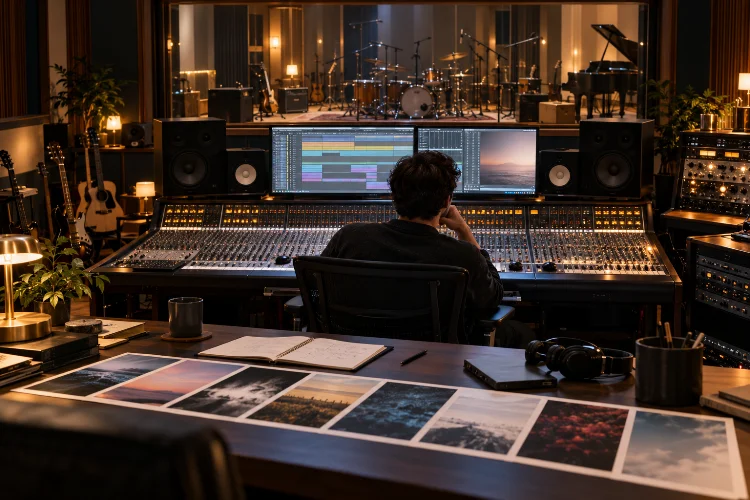
A great song can grab your attention in three minutes. A great album has a harder job: it needs to keep you interested across ten, twelve, or even twenty tracks while still feeling like one complete piece of work.
That difference is where album production choices become especially interesting. Producers are not only deciding how loud the drums should be or which reverb works best on a vocal.
They are also thinking about how songs relate to one another, where quiet moments belong, how the album should begin, and what listeners should feel when the final track ends.
These decisions often go unnoticed because we naturally focus on individual songs. Yet sequencing, sonic consistency, transitions, mastering, instrumentation, and even silence can shape the entire listening experience.
Understanding production beyond individual tracks therefore gives us a better idea of why some albums feel carefully constructed while others simply sound like collections of songs.
Album Production Is About the Bigger Picture
Producing a single song usually involves making hundreds of small decisions. A producer might adjust the arrangement, select instruments, shape vocals, change the tempo, or experiment with effects.
Producing an album adds another level. Every song has to work individually while also fitting into a larger musical environment.
That does not mean every track needs identical instrumentation or production. In fact, too much similarity can make an album boring. The goal is usually to find enough consistency that the listener feels the songs belong together without making everything sound the same.
iZotope describes cohesive album mixing as creating enough consistency that nothing suddenly pulls the listener out of the experience. That can involve bass balance, overall tone, arrangement, and sequencing.
Think of it like designing rooms inside the same house. Each room can look different, but certain details make it obvious that they belong to the same building.
Sequencing Changes How Songs Feel
Track order might seem simple, but sequencing is one of the most important production decisions on an album.
A powerful opening song creates a completely different experience from beginning with something slow and mysterious. Similarly, putting two energetic songs together can build momentum, while following a loud track with something intimate can make the quieter song feel even more emotional.
Creating an Emotional Arc
Producers and artists often think about sequencing almost like planning a live show or movie.
There may be an introduction, rising energy, moments of tension, a centerpiece, and a final resolution. iZotope’s album mastering guidance even suggests thinking of sequencing like arranging several sets during a live performance.
Tempo and key can matter too. Sometimes two individually excellent songs simply feel uncomfortable when placed next to each other.
That is why track sequencing can involve hours of experimentation. Moving one song from track three to track eight may change how the entire album feels.
Sonic Consistency Creates a Shared Identity
Albums recorded over several months may involve different studios, microphones, instruments, producers, or engineers. Without careful planning, the finished project can sound surprisingly disconnected.
Producers often use recurring sonic characteristics to solve that problem.
The same vocal chain might appear across several songs. Similar drum textures, reverbs, synthesizers, guitar tones, or recording techniques can also provide a shared identity.
The result does not have to be perfectly consistant. Small variations are often desirable because they prevent the album from becoming predictable.
Kendrick Lamar’s To Pimp a Butterfly provides a useful example of album-wide sonic thinking. Mix engineer Derek “MixedByAli” Ali explained that Lamar wanted a vintage 1970s character, which contributed to choices such as mixing through analogue equipment and printing mixes to tape.
The team also wanted the album to function as a complete experience from beginning to end.
That kind of direction affects far more than one track. It establishes the sonic world of the entire project.
Transitions Can Turn Separate Tracks Into One Experience
The space between songs is part of production too.
Some albums use several seconds of silence. Others move instantly from one track into another. Producers may also use crossfades, environmental sounds, instrumental passages, dialogue, or sustained notes to connect tracks.
Good transistions can make an album feel almost continuous.
On heavily conceptual records, the end of one song may even function as the introduction to the next. When listeners shuffle the album, the individual tracks still work, but something important is lost.
Sound On Sound has explored album assembly techniques in which intros, endings, tempo changes, and crossfades were adjusted specifically to make songs connect more smoothly.
This shows that album production sometimes continues even after the individual mixes seem finished.
Dynamics Matter Across the Entire Record
Modern production often places a lot of emphasis on making tracks sound powerful, but an album where every song is constantly huge can become exhausting.
Contrast gives listeners room to breathe.
A restrained track can make the following chorus-heavy song feel larger. A sparse acoustic recording can provide emotional relief after several dense electronic productions. Even differences in frequency range and instrumentation can influence perceived intensity.
The important point is that loudness should not always be evaluated seperately.
When mastering an album, engineers compare songs against one another to make sure one track does not suddenly sound dramatically louder, brighter, bassier, or smaller than everything around it.
Sound On Sound describes album mastering as a process of listening to tracks together and adjusting relative loudness, tonal balance, fades, and gaps so the record functions as a cohesive whole.
Those differences may seem small technically, but they can strongly affect how smooth the listening experience feels.
Mastering Is More Than Making Music Loud
Mastering is sometimes misunderstood as simply making a finished mix louder.
Volume is part of it, but mastering an album also involves creating consistency across the entire project. Engineers may adjust EQ, dynamics, stereo balance, track spacing, fades, and relative loudness while constantly comparing songs.
A bass-heavy song might sound fantastic by itself but feel excessive when played immediately after a lighter track. A mastering engineer may therefore reduce some low-end energy, not because the original mix was necessarily bad, but because the song needs to work inside the album.
As mastering engineer Alexander Wright explains in Sound On Sound, mastering decisions often depend on context. Tracks that sound impressive alone can feel unbalanced when placed beside other material.
This is why professional mastering typically involves listening to the record as a complete sequence rather than processing every track in isolation.
Variety and Cohesion Need to Work Together
One of the hardest album production challenges is balancing consistency with surprise.
If every song uses exactly the same instruments, tempo, vocal treatment, and arrangement, listeners may lose interest. But if every track sounds like it came from a completely different artist, the album may lack identity.
Successful records usually live somewhere between those extremes.
A producer might keep the same basic drum aesthetic while dramatically changing instrumentation. Another project might feature wildly different arrangements but use the same vocal ambience throughout.
Sometimes the connection is emotional rather than technical.
This is where production becomes less about rules and more about judgement. Producers have to decide which elements should remain familiar and which ones can change.
The most interesting albums often feel connected without making that connection too obvious. You notice the relationship emotionally before you can necessarily explain it technically.
Listening to Albums Like a Producer
You do not need expensive studio equipment to begin noticing these choices.
The next time you listen to a favorite album, avoid shuffle and pay attention to what happens between songs. Notice whether the energy rises gradually, whether certain instruments return, and whether some tracks sound intentionally wider, darker, quieter, or more intimate.
Listen to the first and final tracks as well.
Do they feel related? Does the ending provide closure? Does the opening establish the album’s atmosphere immediately?
You can also compare songs that sound completely different and ask what still connects them. Maybe it is the vocal production, drum character, lyrical tone, or use of space.
Listening this way can reveal production decisions that were intentionaly designed to disappear into the experience.
Understanding album production choices means looking beyond whether individual songs sound good.
Great records are shaped by sequencing, sonic consistency, dynamics, transitions, mastering, recurring production techniques, and the careful balance between familiarity and variety.
These decisions help turn separate recordings into something that feels like a complete musical statement.
The next time you hear an album you love, try listening from beginning to end with headphones and focus less on the lyrics for a moment. Pay attention to volume changes, track order, recurring sounds, and the spaces between songs.
You may discover that some of the most important production choices are the ones you barely noticed before.